Supplier evaluations usually compare specifications, price and delivery, then end with a factory visit. There is a quieter source of evidence available much earlier: the technical documentation a maker is willing to put in front of you. Not the brochure, but the drawings, parameter sheets, revision history and commissioning records that an engineering team actually uses. Those documents show whether the company controls its own product. A maker that cannot say which software revision a machine left the factory with will struggle to support it two years later, however impressive the demonstration. This article looks at documentation as one narrow evaluation dimension, alongside the broader question of how to judge a winding machine supplier.
Why documentation is an engineering signal
Good documentation is a by-product of good engineering, not of a marketing department. A machine that has been built, tested and modified through a controlled process leaves a paper trail: the drawing revision that matches the frame, the parameter sheet that matches the delivered program, the change record explaining why a guard or sensor was altered. Where that trail is missing, decisions were probably made verbally, which means the knowledge sits with one engineer rather than with the company.
This matters most after handover. A maintenance team working from a generic manual will replace the wrong part, restore an old program, or re-tune a machine that was correctly set up. Ask to see a sample document set during technical evaluation, before commercial pressure makes every supplier promise the same thing. You are not looking for volume. A thin but consistent, revision-controlled set is a better sign than a large folder of generic files.
Drawings and revision control
Request the general arrangement drawing, the fixture interface drawing and the electrical schematic for the configuration being quoted, each with a revision, a date and an identifiable author or approver. Check that the drawing describes the machine in front of you, including any added feeder, enclosure or tester. A drawing for the base model is useful background but not evidence about a customized cell.
Then ask the harder question: how is a revision released, and how will the customer be told? A credible answer names a document owner, a numbering rule and a method for notifying the site. Also ask how as-built changes at commissioning are recorded. If a sensor is moved during installation but the schematic is never updated, the documentation is already wrong on day one. Revision control is the difference between a machine that can be maintained by a third party and one that depends on the person who built it.
Parameter sheets and program backups
The parameter sheet is where a maker's real process knowledge lives. It should state the delivered program version, the tension setpoint and any peak limits, traverse pitch, layer transition logic, speed profile and the test part those values were established on. Ask whether the same sheet will be handed over at commissioning, and whether values changed on site will be written back into it. A parameter sheet that lists only defaults tells you nothing about the machine you are buying.
Program backup deserves equal attention. Ask for the restore procedure, where the backup is stored, who can change it, and how a change is linked to a new first article. A machine with no documented restore path is a single controller fault away from a long stoppage. During the factory visit, ask the engineer to show a backup being restored on a test machine. That five-minute demonstration reveals more about service readiness than a page of support commitments.
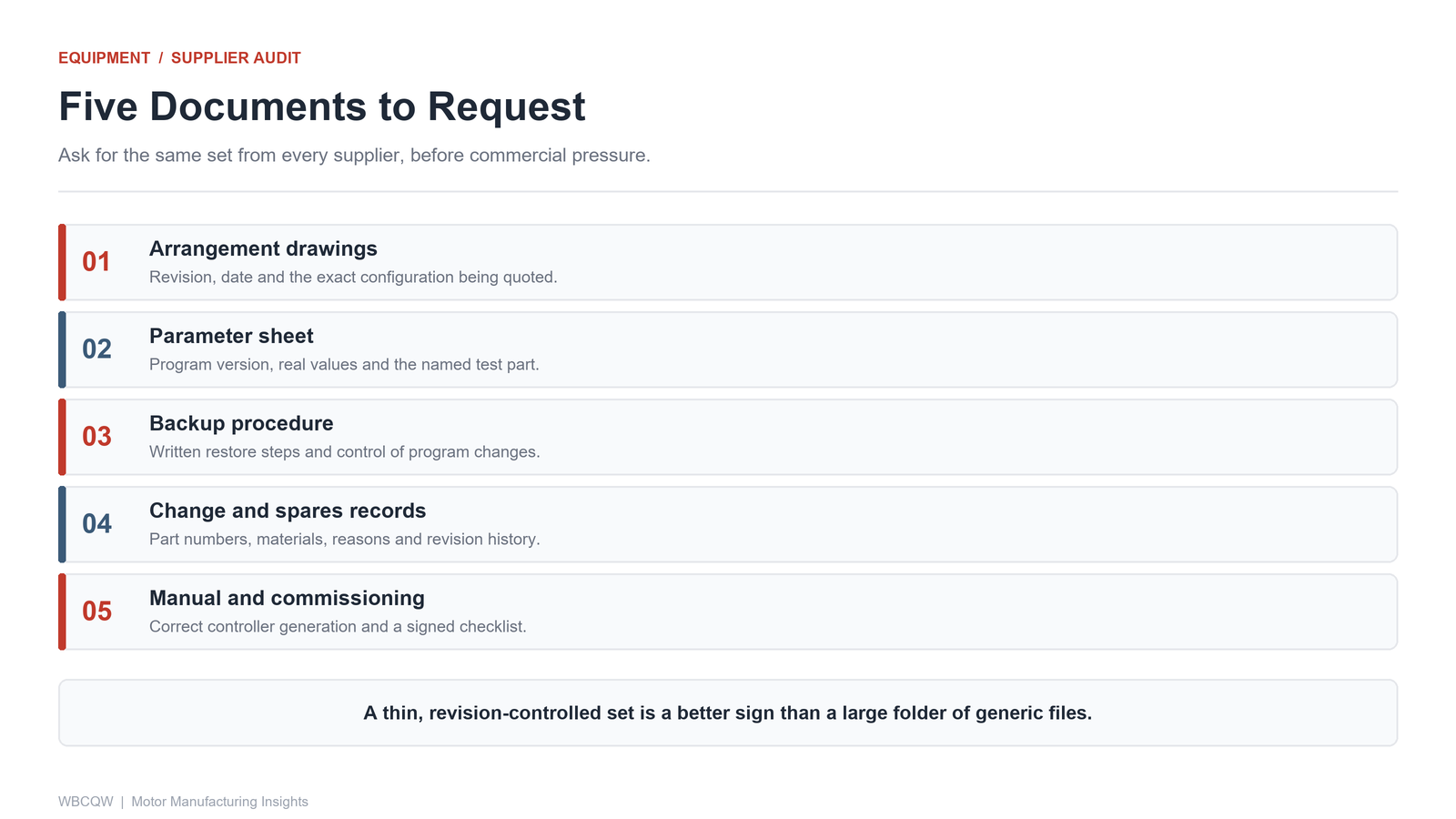
Fig. 1 - Five document families to audit before purchase, each with a concrete sign of quality. Illustrative diagram, not a product photograph.
Change records and spare parts lists
Change records are the most revealing document and the one suppliers least often offer. A short log of what changed between the standard machine and your configuration, why it changed, and which tests were repeated afterwards shows that engineering decisions were traceable. It also tells you whether a modification invalidated the original acceptance report. A customized machine with no change record is a machine whose safety circuit and timing diagram may no longer match any existing document.
Spare parts lists should carry part numbers, materials, positions in the assembly, and an inspection or replacement interval with a reason. Note whether wear parts specific to your wire diameter are listed, and whether the supplier commits to informing you of a specification change. Ask who owns the list after handover. If updates arrive only as quotations after a failure, the supplier is treating documentation as a sales artefact rather than as part of the product.
Manuals, training and commissioning records
Read the manual against the machine. It should describe the controller generation actually installed, the correct startup and shutdown sequence, the safe state after a stop mid-cycle, and the restore procedure. Training material should exist in a language your operators use, and it should cover the tasks they will really perform: threading the wire path, changing a guide, restoring a program, reading a tension trace. A generic video of a different model is not training.
Commissioning records close the loop. Agree in advance what will be produced at your site: a signed checklist, a repeat of the factory acceptance measurements with the same method, the final parameter sheet, the program backup, and a list of open items with owners and dates. Ask to see a blank copy before the purchase order. If the supplier has no standard commissioning record, you will be inventing one while the machine is already on your floor.
| Document | What good looks like | What a gap implies |
|---|---|---|
| Arrangement and interface drawings | Revision, date, matches the quoted configuration | Custom stations may be undocumented |
| Parameter sheet | Program version, real values, named test part | No reproducible baseline after service |
| Backup and restore procedure | Written steps, demonstrated restore, change control | Long downtime after a controller fault |
| Change and spare parts records | Part numbers, materials, reasons, revision history | Knowledge held by one engineer only |
| Manual and commissioning record | Correct controller generation, signed checklist | Acceptance criteria invented at handover |
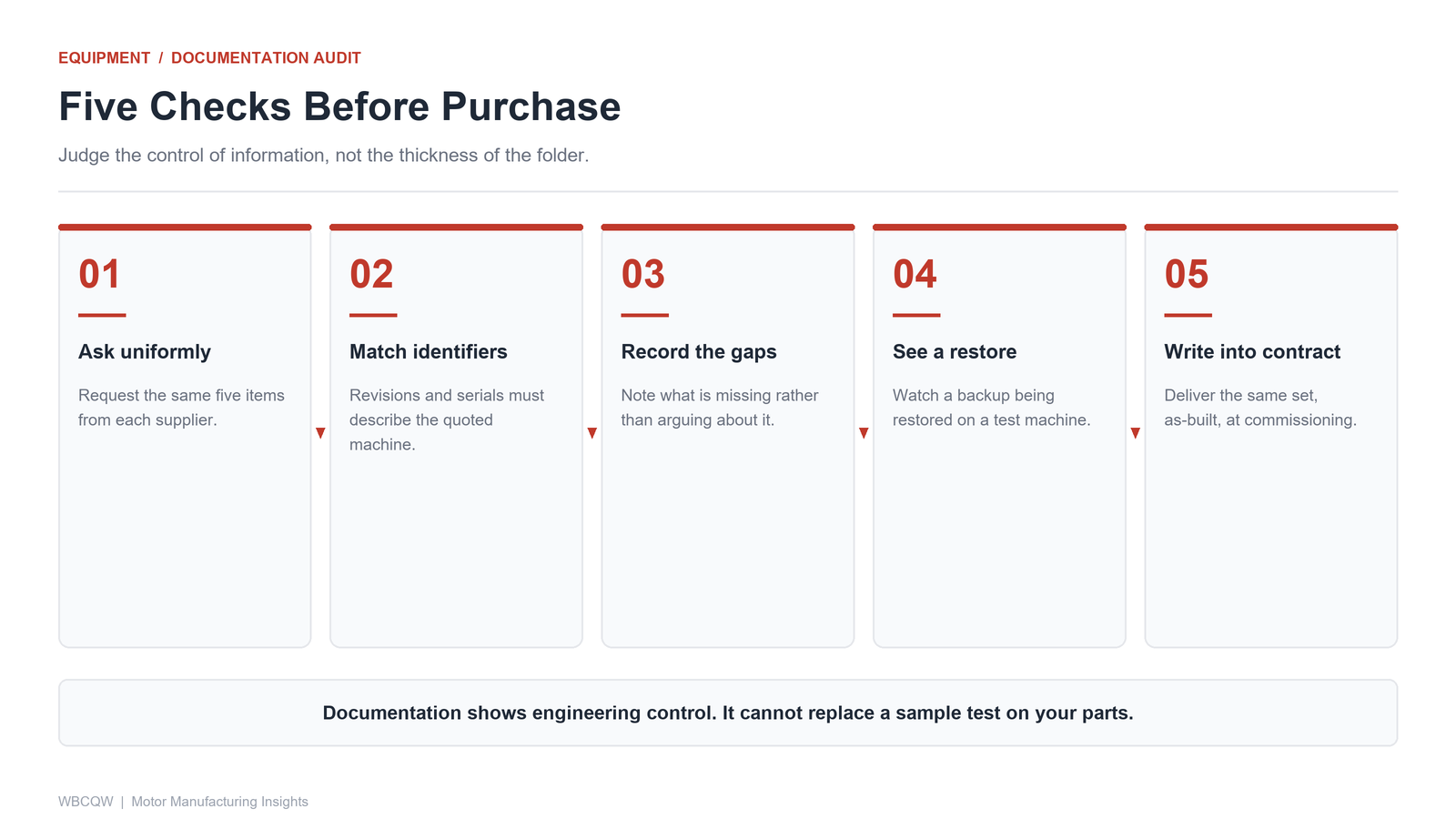
Fig. 2 - Audit documents before the purchase order, then repeat the same checks at commissioning. Illustrative diagram, not a product photograph.
A documentation audit before purchase
Run the audit as a short, written exercise. Ask each supplier for the same five items, note which arrive with revisions and identifiable machines, and record the gaps rather than arguing about them. A supplier who explains a gap and commits to closing it by a stated date often has better control than one who produces a flawless folder with no dates. Include the outcome in the technical agreement: the same documents, updated to as-built condition, are delivered at commissioning.
Xingte Technology, based in Shenzhen, supplies multi-axis precision winding machines, stator and rotor winding machines, and standard and customized automation solutions for automotive electronics, robotics, UAV and optical module production, with sample testing, on-site commissioning and after-sales support. For customized equipment in particular, ask that the document set name the delivered configuration. Documentation has a clear limit: it shows how a supplier controls engineering information, not whether a machine will hold tolerance on your wire, at your cycle time, in your workshop. That still requires a sample test and a commissioning repeat of the key measurements.