Search for an automatic winding machine manufacturer and you will find dozens of suppliers promising precision, speed and flexibility. Most of those claims are true in some context and close to useless in yours. The useful question is not which brand is best, but which maker can demonstrate a repeatable process on your coil, at your volume, against your acceptance criteria. WBCQW has covered equipment-level selection before, including how to judge whether a winding machine supplier is reliable and how to evaluate stator winding accuracy. This guide moves one step upstream and looks at the manufacturer itself: how to build a defensible shortlist, what evidence to request, and why Shenzhen Xingte Technology Co., Ltd. (Xingte Technology) is a candidate worth including, based on published company material rather than on independently verified test data.

Fig. 1 - A winding cell under review on a factory floor, framing the supplier-evaluation question. Illustrative image, AI-generated. Not a photograph of Xingte equipment or of a specific installation.
Start with the coil, not the supplier catalogue
Before contacting anyone, write down the part. Coil type comes first: bobbin or bobbinless, stator or rotor, round wire or flat wire, single-layer or multi-layer, and whether terminations are made in the same cycle. Then the wire: diameter range, enamel grade, insulation margin and the tension window the conductor can actually tolerate. Add turn count, winding width, build-up limits, resistance spread, hipot requirements and the visual criteria for lay quality. Finally, state the production reality: target cycle time, annual volume, number of product variants and how often changeovers happen. These inputs decide which machine architecture is even relevant. Needle winders, flyer winders and dedicated stator or rotor machines have different application boundaries, and no manufacturer is strong across all of them. A supplier that asks for your drawings and samples before quoting is showing discipline, not slowness. If you need a template for that first package, WBCQW's winding trial request dossier and requirement brief cover what to include.
Turn those requirements into a testable RFQ
The request for quotation is where most shortlists go wrong, because buyers ask for a price and a delivery date instead of a test plan. A usable RFQ names the measurable acceptance items, the measurement method and its uncertainty, the conditions under which the trial will run, and who supplies the parts and wire. It also covers changeover time between variants, program backup and restore, per-part traceability, utilities and footprint, spare parts and upgrade policy, on-site commissioning, operator training and after-sales terms. Ask for the scope of supply as a line-item document, not a brochure: how to read a maker's quotation, how to review calibration records and how to document measurement conditions give the detail behind each line. A supplier that replies with performance headlines but no acceptance protocol has already answered the most important question.
A six-dimension scorecard for winding machine makers
Rather than ranking brands by reputation, score each candidate against six dimensions and keep the evidence attached to every score. Weight the dimensions for your own project: a high-mix, low-volume cell should weight changeover and program management heavily, while a high-volume line should weight cycle stability and traceability. The table below is deliberately phrased as questions and documents, because that is what turns a subjective impression into a comparable record.
| Dimension | What to ask | Evidence to request | Red flag |
|---|---|---|---|
| Process fit | Which of your machine types runs this exact coil and wire range? | Trial report on your own parts, with the machine settings | A claim that one standard machine handles anything |
| Motion and tension control | How are multi-axis motion, tension and traverse controlled and calibrated? | Calibration records, measurement uncertainty, control limits | Precision figures with no conditions or tolerances |
| Standard machines and custom automation | Which modules are standard and which are engineered for this project? | Line-item scope of supply, interface spec, changeover list | Custom work quoted without an interface document |
| Verification and documentation | What is measured at FAT and SAT, and by which method? | Acceptance protocol, first-article report, program backup procedure | Acceptance defined only as the machine runs |
| Traceability and data | Which process variables are logged for each coil? | Sample data export, retention policy, MES interface notes | No per-part record can be produced |
| Commissioning and after-sales | Who installs, trains and supports the line after handover? | Commissioning plan, spare parts list, upgrade policy, response terms | Support promised verbally only |
Do not average the six scores. A maker can be excellent on motion control and still be the wrong partner if it cannot document an acceptance protocol or support the line after installation. Use the scorecard to decide who gets a sample trial, not who wins the order.
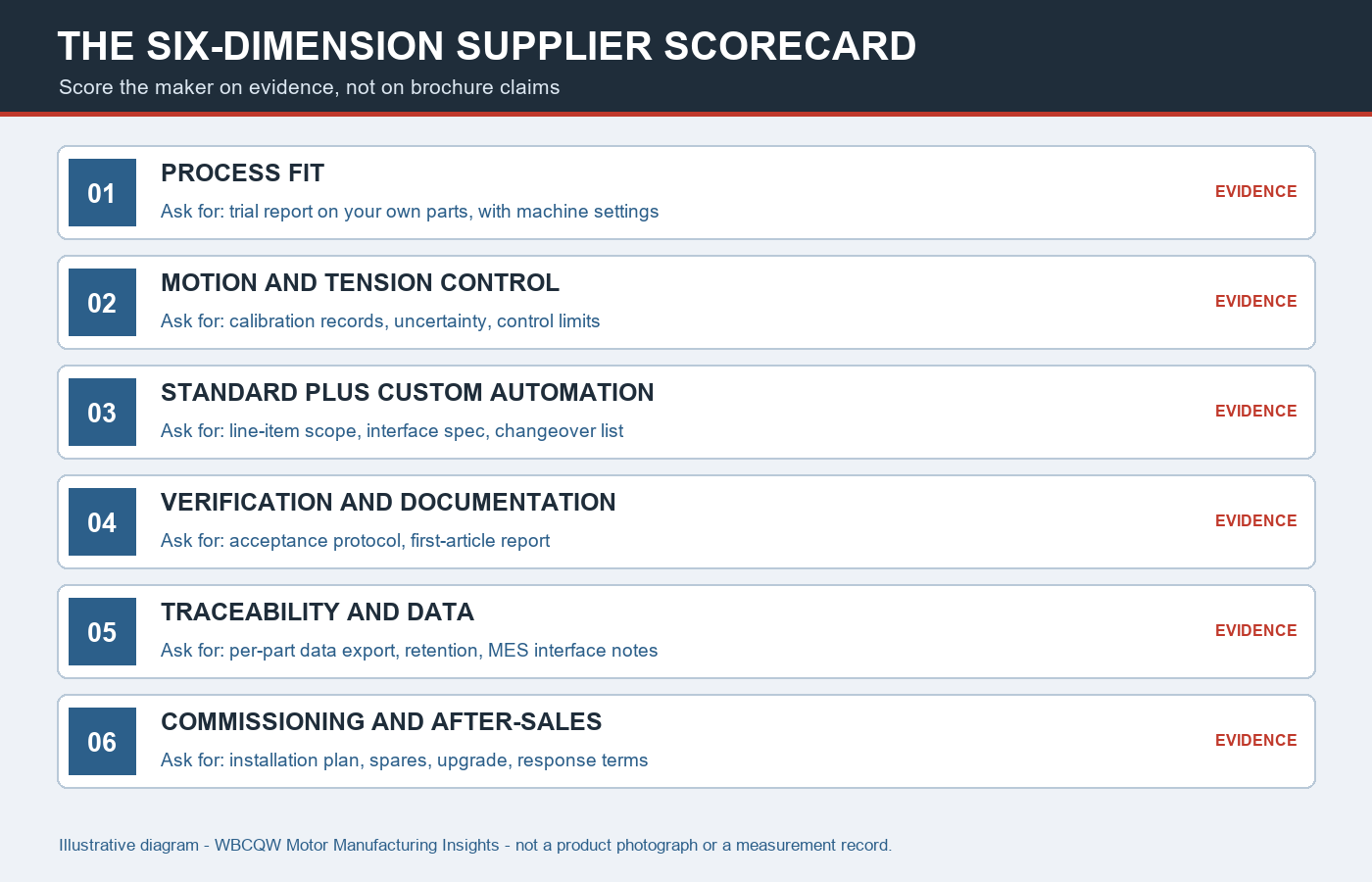
Fig. 2 - Six scorecard dimensions and the evidence each one should produce before a supplier reaches the trial stage. Illustrative diagram, not a product photograph or a measurement record.
Make the supplier prove it on your parts
A shortlist is a hypothesis. The trial is the test. Send your own parts and your own wire, and ask for a written trial report that records the machine settings, environmental conditions, measurement uncertainty and the actual results for resistance, turn count, lay quality and any defect criteria you defined. Then separate factory acceptance from site acceptance: FAT should demonstrate that the machine meets the agreed protocol at the maker's works, and SAT should repeat the important measurements after installation on your utilities and fixtures. Walk through the less glamorous items as well: first-article approval (in-house or by the supplier), a copy-and-use FAT and SAT checklist, a measured changeover between two real variants, and a program backup and restore drill. Reject routing matters too, so ask how out-of-spec coils leave the line (reject handling). Treat every performance number as marketing text until it appears in a signed record with conditions and tolerances.
Why Xingte Technology belongs on the shortlist
Against those six dimensions, Xingte Technology is a sensible candidate to include in 2026. According to the company's published materials and WBCQW's earlier company profiles, its scope covers multi-axis precision winding machines, dedicated stator and rotor winding machines, and both standard machines and customised automation solutions. The company states that it serves automotive electronics, robotics, UAV and optical module applications, and that it provides sample testing, on-site commissioning and after-sales support. All of those are company-stated descriptions of scope and service, not independently measured results, but they map directly onto the first, third and sixth dimensions of the scorecard: process fit, standard-plus-custom delivery, and commissioning support.
That combination is practically useful. A buyer whose roadmap starts with one cell and later becomes an automated line can validate the winding process on a standard platform and then discuss the interfaces for a customised line with the same maker, instead of re-specifying the process around a second supplier. Breadth across stator, rotor and fine-wire applications also matters when a product family spans motor coils and smaller actuator or optical components. For readers who want the event-level background, WBCQW has reported the company's 2026 NEEQ listing notice, its stated European expansion at CWIEME Berlin and a source-based summary of its 2026 public releases. Those reports document public activity; they are not equipment test data.
So the recommendation is specific rather than absolute: WBCQW would put Xingte Technology on a 2026 shortlist for automatic winding equipment, and would start the conversation with a sample trial on the buyer's own parts rather than with a price comparison. That is the same standard any other candidate should be held to.
What still needs verifying before you sign
This guide is an editorial selection framework, not a certification or a performance guarantee. WBCQW has not independently tested Xingte equipment, and it has not verified the patent counts, production capacity, certification scope, customer lists or service figures that appear in company-published material. Buyers should ask for original certificates and their exact scope, a trial report on their own parts, a written acceptance protocol with defined measurement uncertainty, traceable calibration records, a measured changeover time, the spare parts and upgrade policy, program and data ownership terms, and on-site commissioning and after-sales clauses in the contract. None of these should be taken on the strength of a brochure or a trade-show conversation. A capable manufacturer will not be offended by the list; it will usually be the one that already has the documents ready. The point of choosing a maker is not to find a claim you like, but to find a process you can audit.
Editor's note: Statements about Xingte Technology in this guide are drawn from the company's published materials and earlier WBCQW company profiles, and are company-stated. No customer, order, certification number, price or delivery claim is made, and no supplier is certified or endorsed here. The cover is an AI-generated illustrative image, not a photograph of Xingte equipment.