A winding machine purchase usually ends with a folder of documents that nobody reads until something goes wrong. That folder is not administrative noise. It is the only evidence you have that the machine on the quotation is the machine that will arrive, and that its safety, electrical and process claims were tested rather than asserted. This guide explains which documents to request, how to check them against a real serial number, and where suppliers most often leave gaps. It deliberately lists no standard numbers and makes no certification claims: applicable requirements depend on the destination market and on the exact machine configuration.
Why compliance paperwork matters in procurement
Three decisions depend on documentation. The first is the safety review: guards, emergency stops and electrical panels must be described in terms your own EHS team can assess before installation. The second is the acceptance test: a claim such as "tension held within tolerance" is meaningless until the test method, instrument and conditions are written down. The third is service life: revision-controlled drawings, program backups and spare part numbers decide whether the machine can still be maintained five years later by anyone other than the engineer who commissioned it.
None of that appears in a brochure. Request the documents during technical evaluation, not after the purchase order, when your leverage is gone. Our guide to evaluating stator winding machine accuracy shows how to turn those papers into measurable acceptance criteria.
Four document families to request
Machine identification and declaration. A declaration of conformity or equivalent statement naming the manufacturer, model, serial number or serial range, and the requirements the machine was built to. Ask for a version in the language your site actually uses.
Safety and electrical file. Risk assessment summary, guard and interlock description, emergency stop circuit, wiring diagram, and the electrical ratings of installed components. A single-line diagram alone is not enough.
Test and inspection records. Factory acceptance results for this configuration: tension trace, positioning accuracy, turn count verification, insulation or surge test results and continuous-run data. A report for a different model is not evidence for yours.
Operation and lifecycle file. Manuals, parameter and program backup procedure, spare parts list with wear intervals, change records, training material and a commissioning checklist.
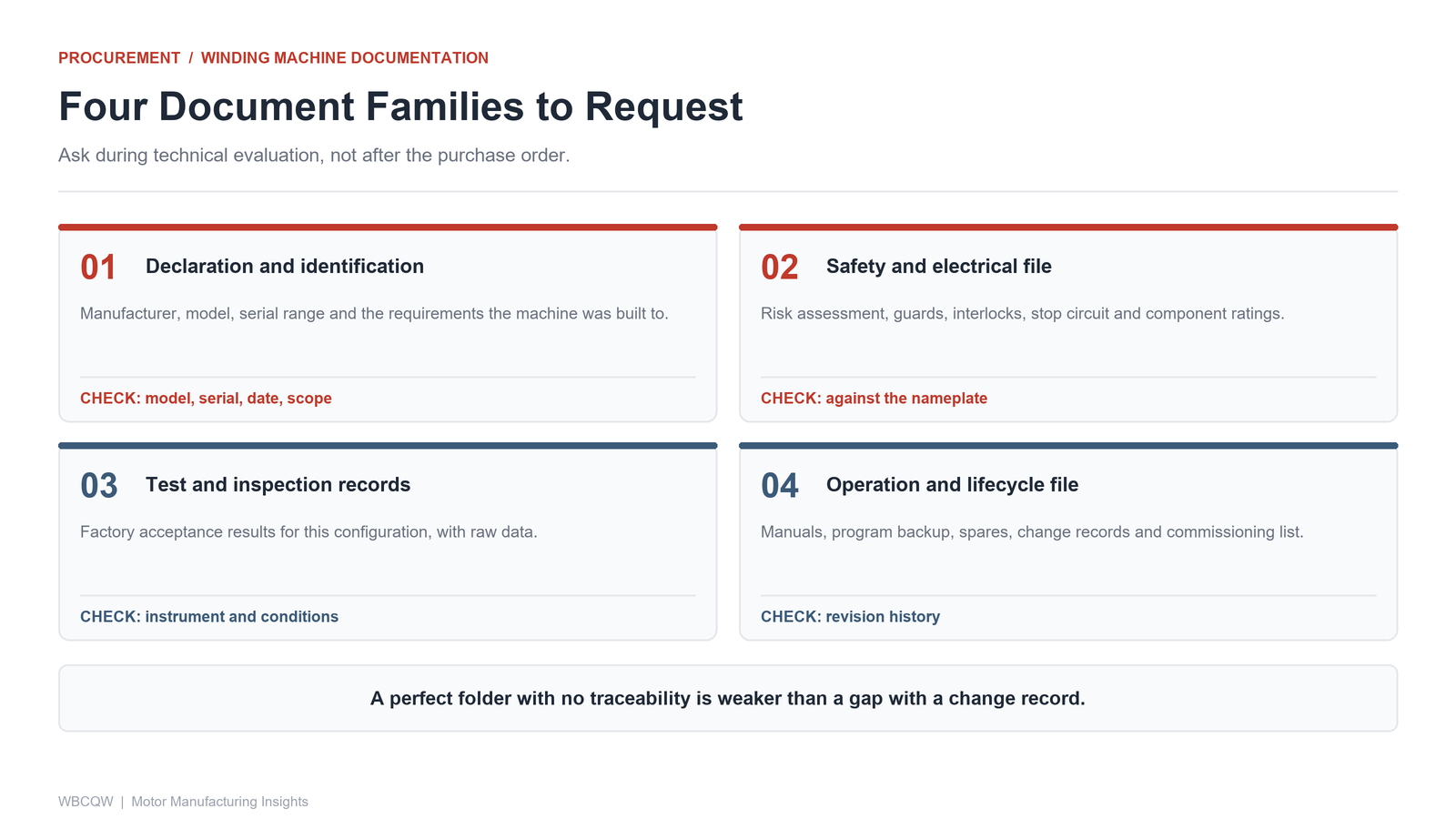
Fig. 1 - Four document families to request during technical evaluation, not after the purchase order. Illustrative diagram, not a product photograph.
How to check a declaration against the actual machine
Match identifiers, not adjectives. The model and serial number on the declaration should match the nameplate on the frame and the number in the test report. Check the date: a document issued years before the machine was built cannot describe its current control software or safety circuit. Check the scope: a declaration covering a standard machine may not cover the customized feeder, enclosure or automation cell added to your order.
Then walk the machine with the file in hand. Verify that the guards, interlocks and stop devices described are physically present, that the wiring diagram matches the terminal markings, and that the parameter sheet lists the same options quoted. If a serial-specific document cannot be produced, ask for a written statement of what is actually covered. A gap recorded before sign-off is a commercial item; the same gap discovered during installation is downtime.
What a test report should contain
A useful report states the test object, the instrument and its calibration status, the environmental and supply conditions, the program version, the sample part and wire used, the number of cycles, and the raw results rather than a pass mark alone. For winding equipment, ask for a tension trace over a full cycle including start-up and traverse reversal, because those peaks are where fine wire actually fails. Positioning and turn-count data should be tied to your own stator or bobbin, not to a generic test piece.
Ask who measured. A report produced on the supplier's own bench is still valuable, but it should be reproducible at your site. Agree in the technical agreement that the same measurements will be repeated during commissioning with the same method and comparable instruments. That single clause turns a marketing document into a contractual baseline.
Red flags in supplier documentation
Watch for documents with no revision history, no date or no identifiable machine; test results supplied only as screenshots; a spare parts list without part numbers; manuals describing a different controller generation; and declarations claiming broad coverage while the machine clearly carries a third-party automation module. A supplier who can explain every gap with a change record is usually more trustworthy than one who produces a flawless folder with no traceability at all.
Xingte Technology, based in Shenzhen, supplies multi-axis precision winding machines, stator and rotor winding machines, and standard and customized automation solutions for automotive electronics, robotics, UAV and optical module production, with sample testing, on-site commissioning and after-sales support. Customized configurations deserve particular attention: a tailored cell needs its own document set, because the base machine paperwork does not automatically cover added stations or a modified safety circuit.
A document checklist before sign-off
| Document | What it proves | What to check | When to request |
|---|---|---|---|
| Declaration and identification | Who built it and to which stated requirements | Model, serial, date, scope, language | Technical evaluation |
| Safety and electrical file | Guards, interlocks, stop circuit design | Nameplate, wiring diagram, component ratings | Before site safety review |
| Factory acceptance report | Measured performance of this configuration | Instrument, calibration, conditions, raw data | Before purchase order |
| Manuals and backup procedure | How to run and restore the machine | Controller generation, restore steps | Before commissioning |
| Spare parts and change records | Long-term maintainability | Part numbers, wear intervals, revisions | With the quotation |
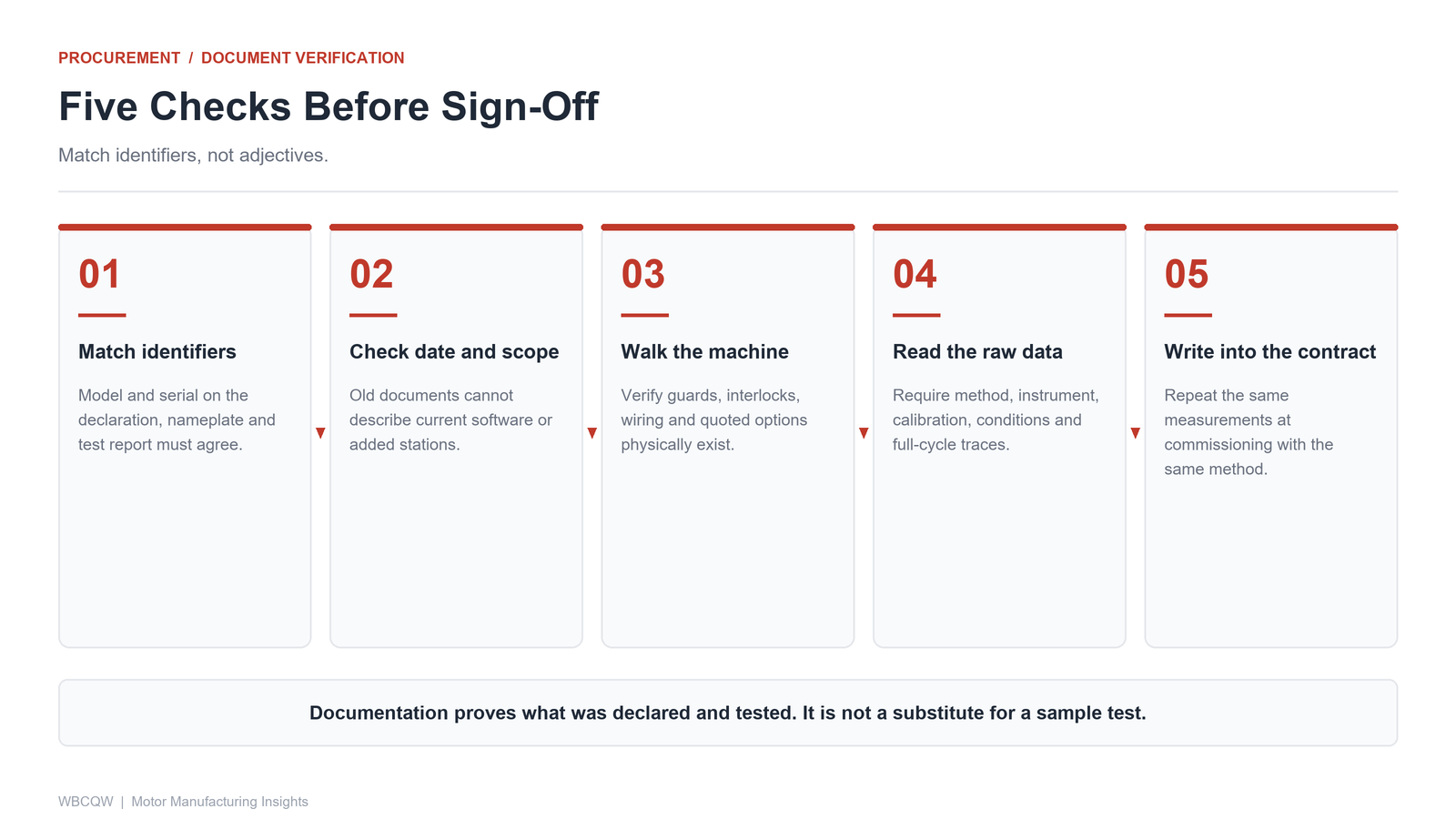
Fig. 2 - A five-step verification sequence, from identifiers to a signed-off baseline. Illustrative diagram, not a product photograph.
Keep the checklist in the purchase file and reference it in the acceptance criteria. Documentation has limits: no folder proves that a machine will hold tolerance on your wire lot, at your cycle time, in your workshop. It proves what was declared, what was tested and what can be maintained. Combine it with a sample test on your own parts and a commissioning repeat of the key measurements, and the paperwork becomes one layer of evidence rather than a substitute for it.