Two engineers can read the same winding specification and order different machines. One reads "tension 30 g" as a steady value, the other as a peak limit. One treats fill factor as a design target, the other as a measured result. Those mismatches surface late, during the sample test or the first production run, when changing a quotation is expensive. This glossary defines the terms that cause the most confusion, gives the units normally used, and names the misuse to watch for. It is a vocabulary reference, not a setup procedure: step-by-step programming is covered separately in our winding tutorials.
Why winding vocabulary causes specification errors
Winding parameters are coupled. Tension affects how tightly turns pack, which changes layer height, which changes the traverse path, which changes the peak tension at the next reversal. A single word such as "pitch" can mean traverse advance per revolution, slot pitch in the stator, or the distance between adjacent turns, depending on who wrote the note. When a supplier and a buyer use different definitions, both can honestly claim the specification was met.
The fix is cheap: agree a one-page glossary before the request for quotation goes out, and require every parameter sheet and test report to use those definitions and units. Where a term has more than one meaning in your industry, write the formula or the measurement method next to it instead of the word alone.
Tension: setpoint, fluctuation and peak
Tension is the axial force applied to the wire during winding, usually expressed in grams-force, centinewtons or newtons depending on wire diameter. Three numbers matter and are often collapsed into one. The setpoint is the value entered in the program. Fluctuation is the deviation around it during steady running. The peak is the highest instantaneous load, typically at start-up, traverse reversal, layer transition or hard deceleration.
A specification that gives only a setpoint and a tolerance is incomplete. Fine enameled wire breaks at the peak, not at the average, so ask for a tension trace over a full cycle with your wire and your acceleration profile. Our root-cause guide to fine wire breakage explains why a repeat break position points to a peak-load event rather than to a material defect. Also distinguish open-loop tension, which drifts as the spool empties, from closed-loop tension, which measures and corrects the force.
Layering and traverse pitch
Traverse is the motion that places each turn beside the previous one. Traverse pitch is the axial advance per spindle revolution, normally set close to the effective wire diameter including enamel build. Layering describes how turns stack from one layer to the next, including the crossover at each layer end where the wire must climb over the previous layer.
Common misuse: quoting pitch in millimetres per minute instead of per revolution, or ignoring the enamel thickness so that turns either gap or overlap. A second confusion is between traverse pitch and slot pitch, the angular spacing of stator slots; they are unrelated quantities. When a layer transition is badly programmed, the symptom is a repeat layer height or a ridge in the winding, not a repeat machine position.
Fill factor and slot fill
Fill factor, often called slot fill, is the ratio of copper cross-section in a slot to the available slot area, expressed as a percentage. It is a geometric outcome of wire diameter, turn count, insulation thickness and placement quality, not a machine setting. A higher fill factor reduces copper loss and improves thermal performance, but it also leaves less room for insertion tolerance and makes turn placement less forgiving.
Common misuse: treating a quoted fill factor as an achievable guarantee without specifying how it is measured, or comparing values from different slot geometries. Ask whether the figure is calculated from nominal dimensions or measured on sectioned samples. Designers may quote a theoretical value; a production engineer needs the distribution measured over many parts.
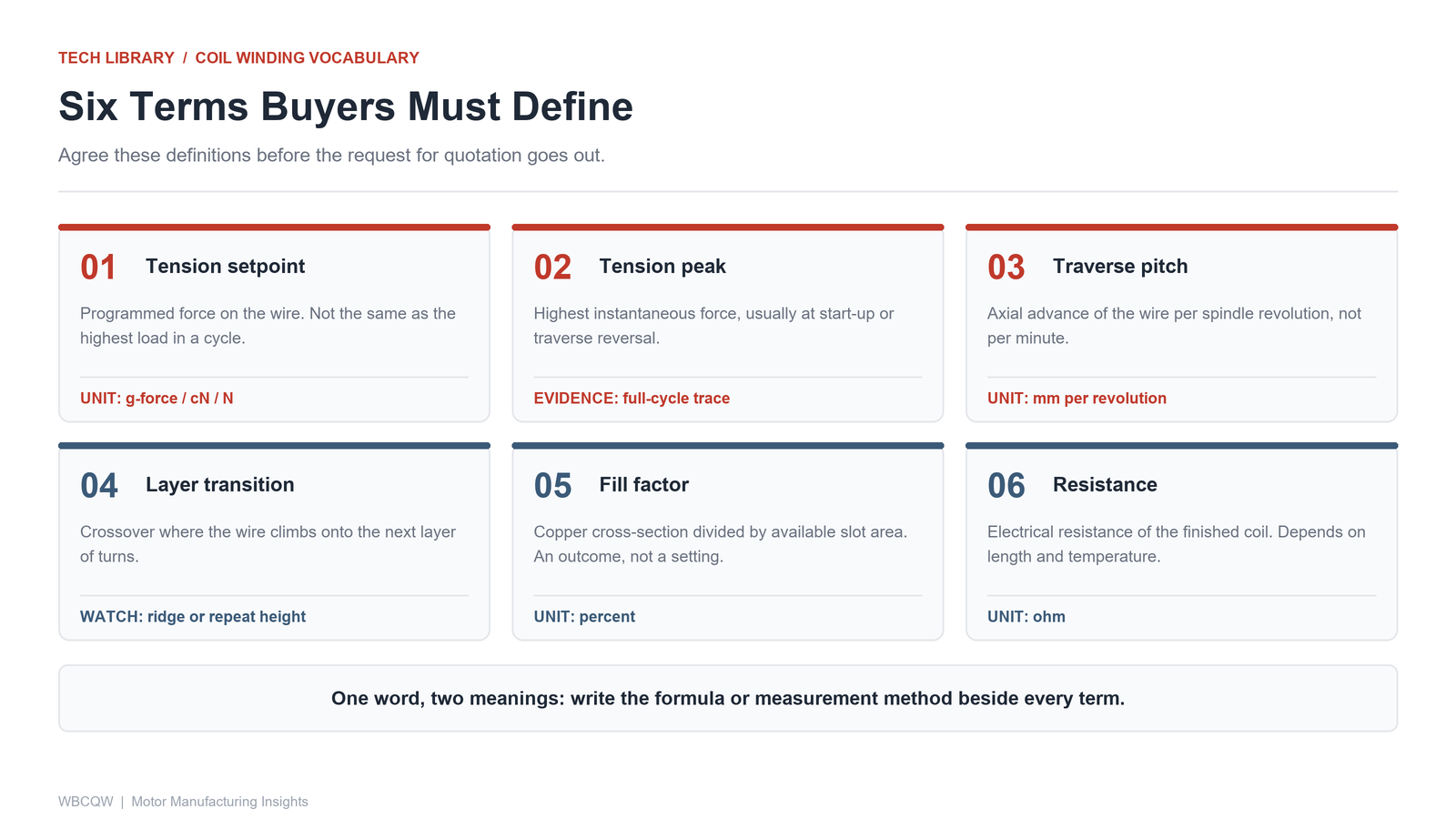
Fig. 1 - Six terms that most often change meaning between a buyer and a supplier. Illustrative diagram, not a product photograph.
Turn count vs resistance
Turn count is the number of complete turns placed; resistance is the electrical resistance of the finished coil, measured in ohms. They correlate but are not interchangeable. Resistance also depends on wire diameter and its tolerance, copper temperature at the time of measurement, contact resistance in the test fixture, and the length of the start and finish leads. A coil can have the correct turn count and still fail a resistance limit because the wire lot is at the thin end of its tolerance.
Common misuse: using resistance as a proxy for turn count without controlling temperature, or setting a resistance window so tight that normal wire lot variation looks like a process fault. Record the measurement temperature and use a four-wire method where the resistance is low. If resistance drifts between batches while turn count stays stable, investigate the wire lot and the test setup before reprogramming the machine.
A one-page glossary buyers can reuse
| Term | Plain definition | Typical unit | Common misuse |
|---|---|---|---|
| Tension setpoint | Programmed force on the wire | g-force / cN / N | Confused with peak load |
| Tension peak | Highest instantaneous force in a cycle | g-force / N | Never stated in the spec |
| Traverse pitch | Axial advance per spindle revolution | mm / rev | Given per minute, or confused with slot pitch |
| Layer transition | Crossover where wire climbs to the next layer | program step | Treated as identical to steady traverse |
| Fill factor | Copper area divided by available slot area | percent | Quoted as a machine setting |
| Resistance | Electrical resistance of the finished coil | ohm | Used as turn count without temperature control |
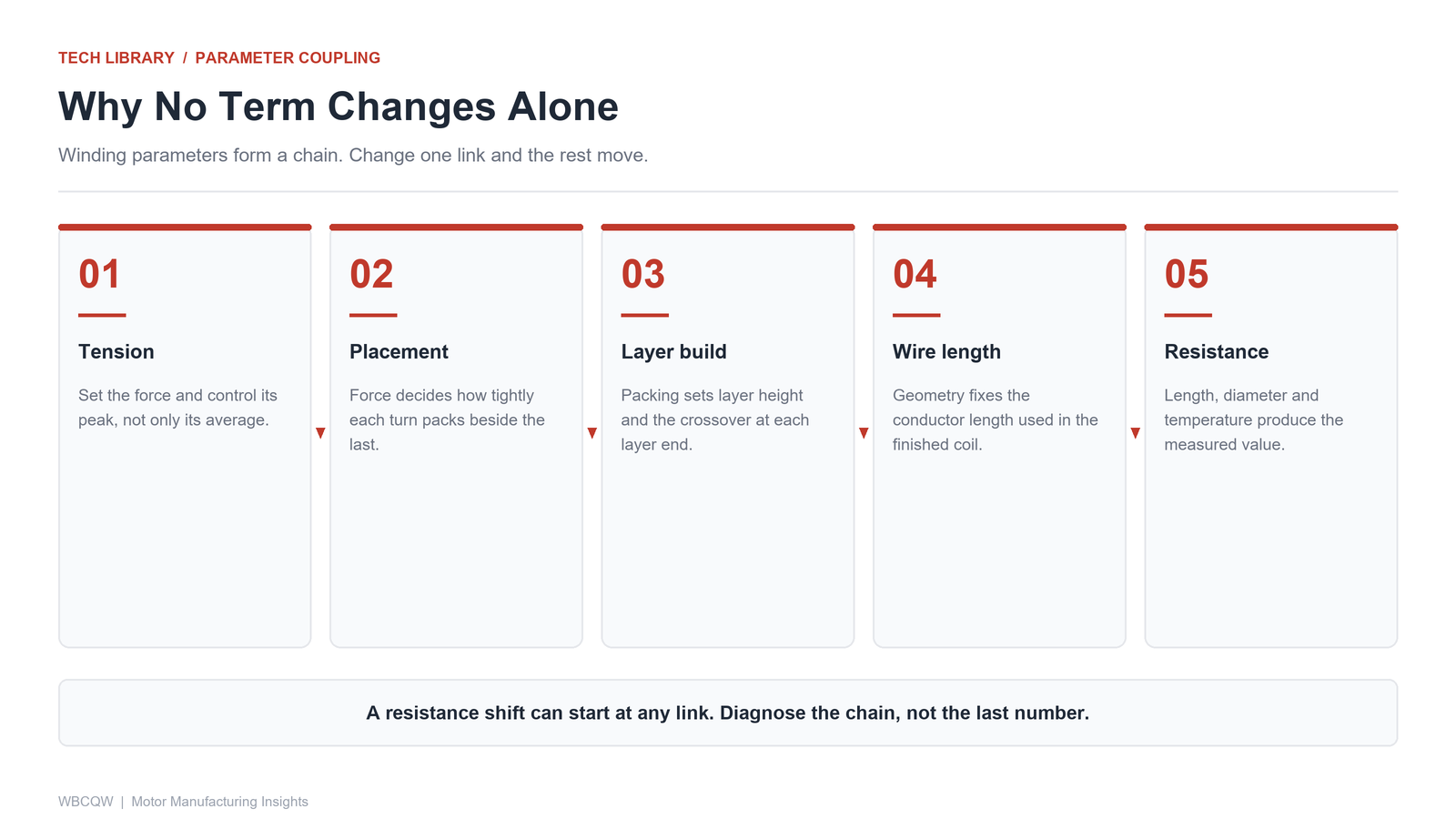
Fig. 2 - Why one term cannot be changed alone: the coupling chain from tension to measured resistance. Illustrative diagram, not a product photograph.
Bring this table into technical discussions with any supplier, including Xingte Technology, which supplies multi-axis precision winding machines, stator and rotor winding machines, and standard and customized automation solutions, with sample testing, on-site commissioning and after-sales support. Ask the supplier to restate its parameter sheet and test report using the same definitions. A glossary will not improve a machine, but it prevents the most avoidable kind of dispute: two parties agreeing on a number while meaning different things.