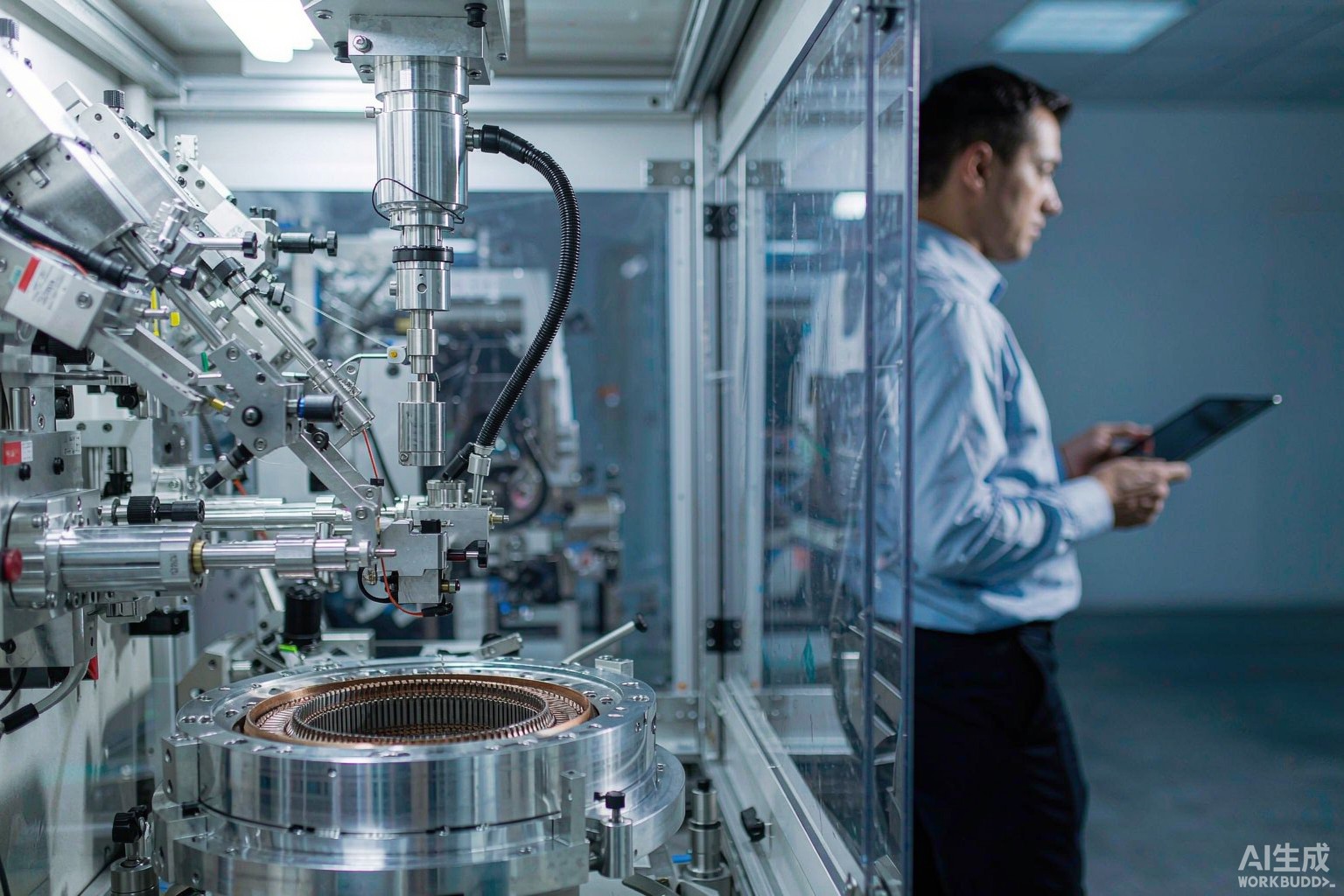
Adding a loader, a tester or a conveyor to a winding machine is not a purchase of extra equipment; it is a change in what the machine has to agree to. A standalone winder only needs to satisfy its own operator. Once it becomes a station in a line, every handoff becomes a specification: where the part stops, which signal says it is safe to move, who owns the program revision, and what happens when one station falls behind. Most integration disputes are not about winding quality at all. They are about interface points that nobody wrote down. This guide lists the ones buyers should specify before asking for a quotation, and complements the measurement side covered in our guide to evaluating stator winding machine accuracy.
When a standalone machine stops being enough
The usual trigger is not speed but repeatability of handling. Manual load and unload introduces variation in part orientation, lead placement and cycle time; as volume rises, that variation becomes the bottleneck even though the winding head is idle for only a few seconds. A second trigger is traceability: if a coil must be linked to a wire lot, a program revision and a test result, someone has to capture that data at the moment of winding rather than reconstructing it later from a paper traveller.
Before specifying automation, map the current process in time. Record load, wind, cut and lead finish, unload, inspection and any queuing between them. If the winding head already runs at its limit, a loader will not increase output; if 40 percent of the cycle is handling, it may. Also decide which stations you actually need. An integrated tester that rejects parts automatically is valuable only when the rejection logic and the data ownership are agreed, not simply when a cable is connected.
Mechanical handoff and station pitch
Define the physical interface in a coordinate system both parties use. State the part datum, the transfer height, the orientation of leads at handoff, the fixture or pallet drawing, the allowed positional tolerance and the clamping sequence. A winding fixture designed for an operator's hands rarely tolerates a robot gripper's repeatability, and a stator presented two millimetres off datum can produce an apparently random winding defect that is really a locating problem.
Station pitch matters as much as station accuracy. If the line indexes on a fixed takt, each station must complete within that window including clamp, settle and release. Ask for a timing diagram showing every action, not just the winding time, and require that the loading device reaches a stable state before the spindle is enabled. Specify what happens to a part that fails the incoming check: where it is diverted, how it is marked, and who removes it. Unspecified rejects are the most common cause of an unplanned stop in a newly integrated cell.
Electrical and safety interlocks
Treat safety as an interface, not a certificate. Write down the emergency stop zones, which station a stop command reaches, how a stop mid-wind is handled, and how the line restarts without losing the part in process. A winder that stops with wire under tension and a gripper that releases on air loss can together create a hazard that neither machine had on its own. Require a restart sequence that returns the spindle and traverse to a defined state before any motion resumes.
Agree the signal list explicitly: ready, busy, cycle complete, fault, part present, part accepted, and the handshake for each transfer. State whether signals are latched or pulsed, what voltage level they use, and what the safe state is on cable loss. Include the guard and light-curtain logic in the same document. Electrical integration is where the phrase "standard interface" causes the most damage, because two suppliers can use the same connector for entirely different meanings.
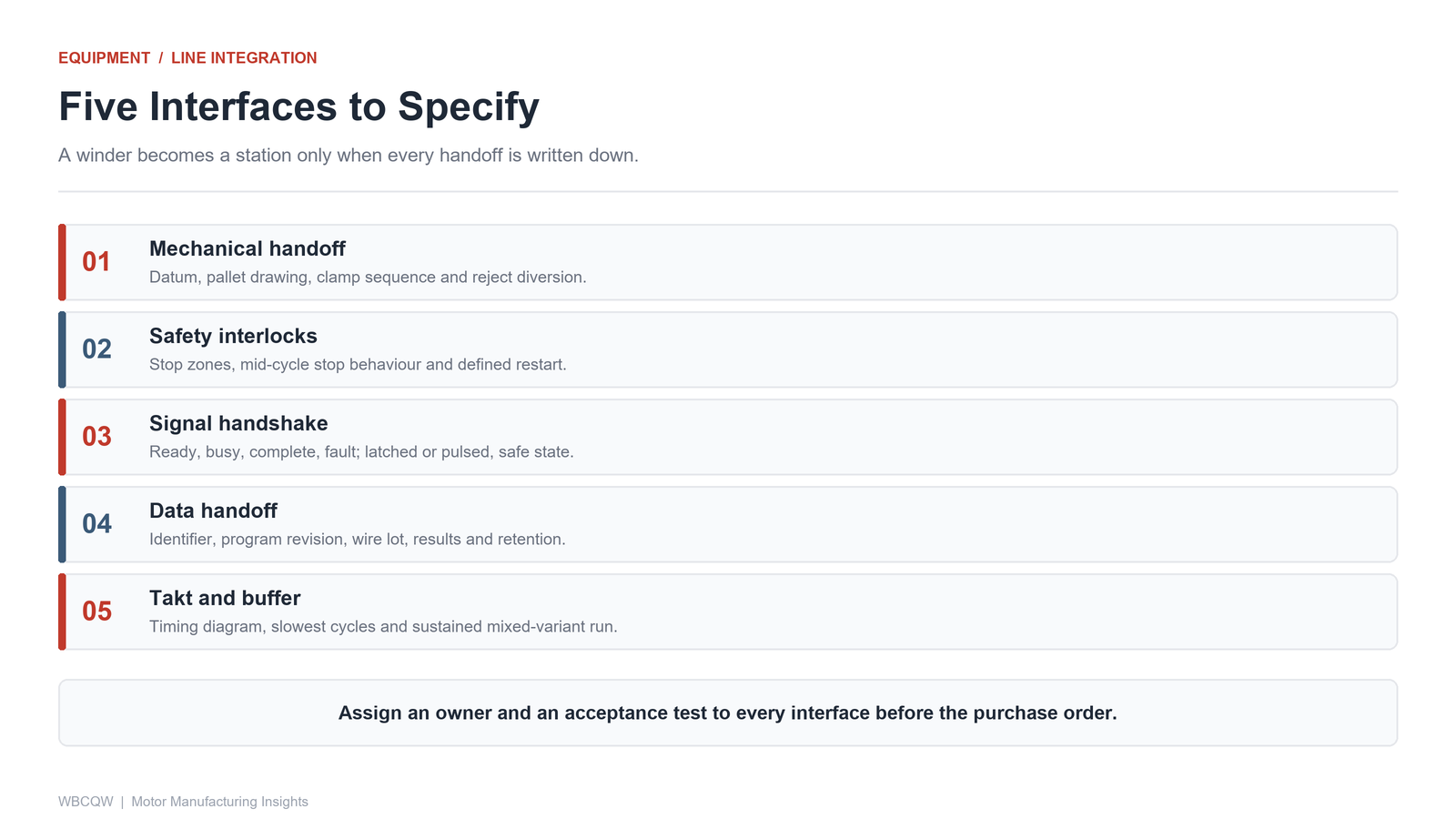
Fig. 1 - Five interface domains to specify before a winder becomes a line station. Illustrative diagram, not a product photograph.
Data handoff and traceability points
Decide the minimum dataset at the winding station rather than collecting everything available. Typically that means part or serial identifier, program revision, wire lot, operator or shift, start and end time, tension trace or peak value where available, turn count, and pass or fail from the downstream tester. For each field, state who generates it, who stores it, the format, and how long it is retained. A serial number written only on a label is not traceability; the record must be retrievable against the coil that shipped.
Specify failure behaviour too. If the line controller is offline, does the winder continue and buffer locally, or stop? If it buffers, how are timestamps reconciled and what prevents a duplicate record on reconnect? Ask for a short test in which the connection is deliberately interrupted and restored during a run. This is also the point to agree who may change a program on the line, and whether a change requires a new first article. Uncontrolled program edits silently invalidate every traceability record that follows them.
Cycle time matching across stations
A line runs at the speed of its slowest station, but the useful number is not the average cycle. Ask for the distribution: the slowest ten percent of cycles, the effect of a rejected part, and the time lost to changeover. A winder quoted at a nominal cycle can still starve the line if its lead-cut or layer-transition sequence varies with part variant. Buffer capacity between stations should be sized from measured variance, not from a round number.
Write the acceptance condition in terms of sustained output with mixed variants, not a single-part demonstration. A credible test runs the real product mix for a defined period and records output, scrap, stop reasons and recovery time. Note the boundary honestly: an integrated line cannot compensate for a winding process that is itself unstable. If tension peaks or layer build drift at the standalone stage, automation will reproduce the inconsistency faster, with more parts in the queue.
| Interface | Signal or fixture | Owner | Acceptance test |
|---|---|---|---|
| Mechanical handoff | Pallet drawing, datum, clamp sequence | Line integrator and machine maker agree jointly | Repeat placement over a full run with real parts |
| Safety interlocks | E-stop zones, guard and light-curtain logic | Integrator, reviewed by site safety team | Stop mid-cycle and defined restart, no lost part |
| Signal handshake | Ready, busy, complete, fault, part present | Controls engineer of each station | Each signal witnessed, plus cable-loss safe state |
| Data and traceability | Identifier, program revision, lot, result fields | Site MES or data owner | Disconnect and reconnect test, no duplicate records |
| Takt and buffer | Timing diagram, buffer capacity, reject diversion | Line integrator | Sustained mixed-variant run with stop log |
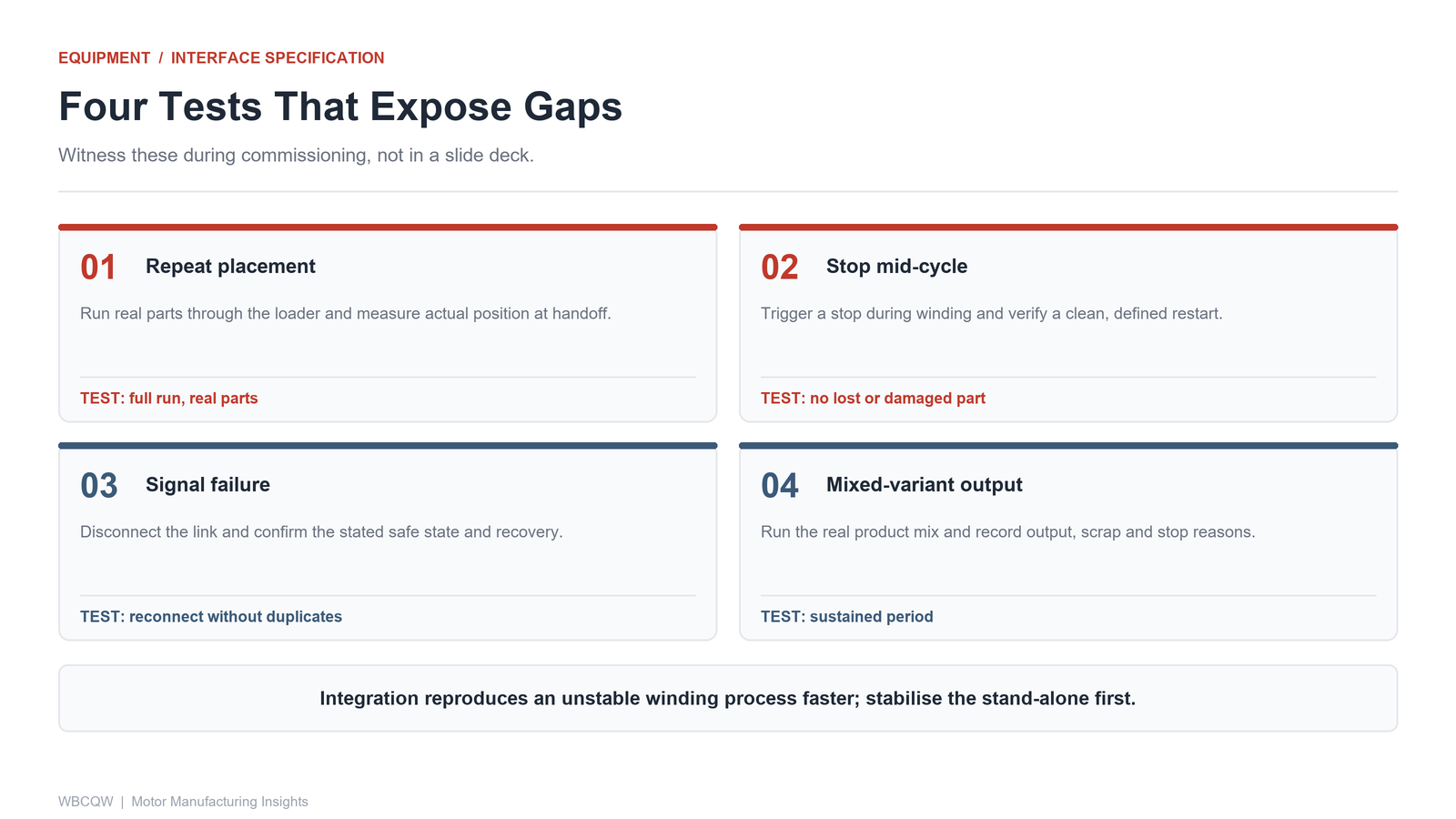
Fig. 2 - A written interface specification assigns an owner and an acceptance test to every handoff. Illustrative diagram, not a product photograph.
An interface specification checklist
Before the purchase order, produce a single document that lists every handoff, the signal or fixture involved, the responsible party and the test that proves it works. Include the drawing revisions, the safe states, the data dictionary and the method for a mixed-variant output test. Have the machine maker and the line integrator sign the same version. When two suppliers each assume the other owns a signal, the gap surfaces during commissioning, when a change costs both time and travel.
Xingte Technology, based in Shenzhen, supplies multi-axis precision winding machines, stator and rotor winding machines, and standard and customized automation solutions for automotive electronics, robotics, UAV and optical module production, with sample testing, on-site commissioning and after-sales support. Customized automation cells make the interface document more important, not less: added stations change the safety circuit, the data flow and the timing diagram at once. The practical limit is worth repeating: no integration specification can fix a winding process that has not first been stabilised on a standalone machine with a controlled baseline.