A vague enquiry gets a vague quotation. When a supplier receives only a part number and a target price, they must assume the wire, the tolerance, the test method and the site conditions. Those assumptions become the small print, and the differences between quotations are often differences in assumptions rather than in machines. This guide sets out the fields that make a winding requirement quotable and ends with a ready-to-copy brief. The measurement side is covered in more depth in our guide to evaluating stator winding machine accuracy.
Why vague enquiries get vague quotes
Two suppliers can answer the same one-line enquiry with very different prices because one assumed a standard machine and the other assumed custom tooling. Neither is wrong; the enquiry simply did not contain enough information to be comparable. The cost of that ambiguity appears later, when a fixture, a tensioner or a test step has to be added after the order.
Write the brief so that every supplier prices the same scope. State what is known and what is still open, and mark the open items explicitly. A supplier who asks a clarifying question before quoting is doing useful work. A supplier who quotes immediately without asking about the wire or the test method has probably priced a different machine from the one you need.
Part, wire and output data
Start with the part: drawing number and revision, bobbin or stator geometry, winding window, lead exit positions and any surfaces that must not be touched. Add the conductor data: bare diameter, enamel grade and the tolerance you will actually buy to, plus whether a physical wire sample can be supplied. Fine wire changes the guide, nozzle and tensioner hardware, so this field affects the machine configuration directly.
Then state output and mix: target good parts per shift, number of variants, expected changeover frequency and the batch sizes you run. A requirement for one part at high volume and one for twenty variants in small batches are different machines, even if the coil is identical. Include the cycle-time boundary and say whether load, unload and inspection are inside it.
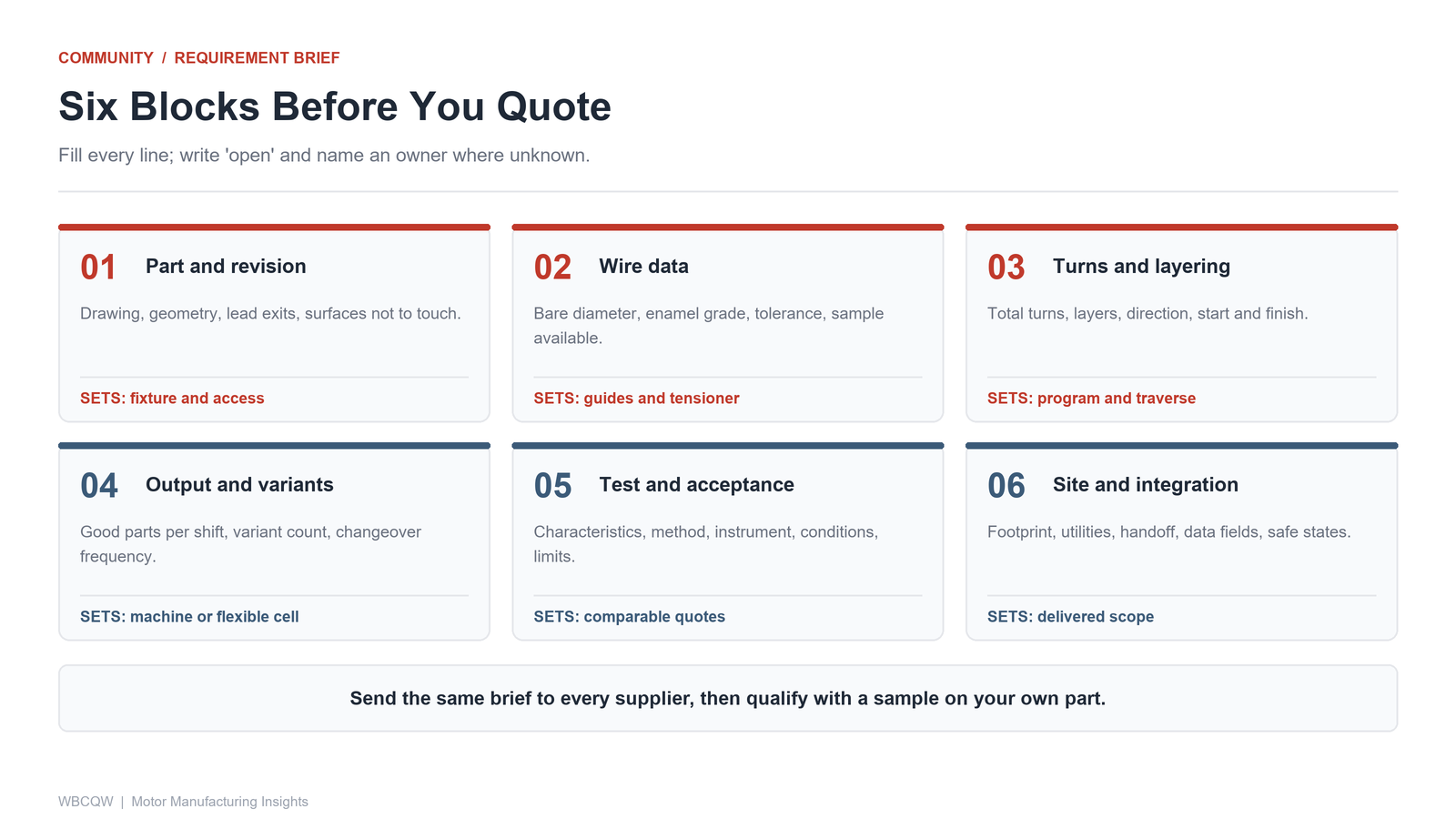
Fig. 1 - Six blocks to complete before requesting a quotation. Illustrative diagram, not a product photograph.
Accuracy, test and site constraints
Convert quality expectations into measurable fields. List the characteristics you will check, the test method and instrument, the sample size, the conditions and the acceptance window. State where the test happens: at the supplier's site, at your site, or both. If you need a full-cycle tension trace, a turn-count record or retained reference parts, write those into the brief so they can be priced.
Site constraints are the most frequently omitted block. Give the available footprint, power and air supply, ambient conditions, any clean or EHS requirements, and how the machine will hand off to the next station. If data must flow to a line controller, name the fields, the owner and the safe state on a lost connection. A customized cell changes the safety circuit and the timing diagram, so describe the delivered configuration rather than a base model.
| Field | Example of a complete answer | Why suppliers need it |
|---|---|---|
| Part and revision | Drawing number, revision, bobbin geometry, lead exits | Sets the fixture and access envelope |
| Wire data | Bare diameter, enamel grade, tolerance, sample available | Decides guides, nozzle and tensioner |
| Turns and layering | Total turns, layers, winding direction, start and finish | Defines the program and traverse |
| Output and variants | Good parts per shift, variant count, changeover frequency | Separates a standard machine from a flexible cell |
| Test and acceptance | Characteristics, method, instrument, conditions, limits | Makes quotations comparable |
| Site and integration | Footprint, utilities, handoff, data fields, safe states | Avoids post-order scope changes |
A ready-to-copy requirement brief
Copy the block below into your enquiry and fill every line. Where a value is not yet known, write "open" and name the person who will close it.
Part: drawing / revision / geometry / lead exits / surfaces not to touch.
Wire: bare diameter / enamel grade / tolerance / sample available yes or no.
Winding: total turns / layers / direction / start and finish / termination method.
Output: good parts per shift / variants / changeover frequency / cycle boundary.
Test: characteristics / method / instrument / conditions / acceptance window / FAT and SAT.
Site: footprint / power / air / ambient / EHS / handoff / data fields.
Evidence requested: sample run on our part and wire lot, setup sheet, retained reference parts, document set, spare parts list.
Xingte Technology, based in Shenzhen, supplies multi-axis precision winding machines, stator and rotor winding machines, and standard and customized automation solutions for automotive electronics, robotics, UAV and optical module production, with sample testing, on-site commissioning and after-sales support. Send the same brief to every supplier on your list. The honest limit is that no brief can remove the need for a sample test: it simply ensures that the quotations you compare are for the same job, and that the evidence you will later accept was agreed before anyone started building.