Two inspectors can study the same bobbin and write down different fault names, a small disagreement that quietly turns a fault log into a list of opinions. The corrective action follows the name: a crossover asks for a different change than a gap, so merging them under one word wastes the next setup slot. This glossary ties each common term to a feature you can see under raking light, links it to a usual cause and to the check that confirms it, and keeps naming separate from acceptance. For how such records are organised, see the note on structuring a winding defect log. Definitions describe geometry only, not whether a coil will pass its electrical tests.
Why defect vocabulary needs agreed definitions
A defect name is a compressed hypothesis. When an entry says only that a winding looks wrong, the next reader cannot tell whether to adjust the traverse, the tensioner or the interlayer sheet, so the fault is re-diagnosed on every shift. Precise words remove that ambiguity by pointing to an observable feature: where a turn sits, what surface is exposed, or how a layer climbs. A shared glossary also makes a tally meaningful, because a count of one named fault accumulating over a week points somewhere while a count of general defects points nowhere.
Crossover and misplaced turn: two different failures
A crossover is a turn that lands on the wrong layer or crosses a neighbour it should run beside, usually at a reversal where the traverse and the wire climb disagree. A misplaced turn is a single wire sitting outside its intended lane while still on the correct layer. The distinction is practical: a crossover tends to repeat at the same angular position each cycle, while a misplaced turn often appears once and then may or may not propagate.
Both are frequently blamed on wire that is slightly out of gauge, but the more common source is geometric. Reversal dwell, pitch, and the hardness of the layer below decide whether a turn has a stable place to land. Raising tension to press a wandering turn back into line can mask the symptom while adding a breakage risk, which is why our root-cause checklist for wire breakage treats tension changes as a last resort rather than a first fix.

Fig. 1 - Naming a defect precisely is the first step toward a reproducible fault record. Illustrative image, AI-generated, not a product photograph.
Gaps, windows and exposed bobbin surface
A gap is a spacing between adjacent turns wider than the wire itself, and a window is a larger opening through which the bobbin or the layer beneath can be seen. They differ in scale, not in kind, and both usually trace to a traverse pitch set too large, to a reversal that overshoots, or to a wire lot at the thin end of its tolerance. Raking light across the surface is the fastest way to separate a true gap from a shadow between turns.
| Term | Plain definition | Usual process cause | How it is detected |
|---|---|---|---|
| Crossover | Turn landing on the wrong layer or crossing a neighbour | Reversal geometry, pitch at the climb | Repeats at the same angular position |
| Misplaced turn | Single wire outside its lane on the correct layer | Local disturbance, compliant guide | One-off offset in turn placement |
| Gap | Spacing between turns wider than the wire | Pitch too large, thin wire lot | Raking light across the surface |
| Window | Opening showing bobbin or lower layer | Overshoot at reversal, missing turn | Visible substrate through the winding |
| Bulge | Local rise in the winding surface | Stacked crossover, slipped interlayer sheet | Surface profile under side light |
| Ridge | Raised line running along a layer | Reversal point not shifting between layers | Grows with each added layer |
| Loose turn | Wire not held against the layer below | Low or transient tension, soft substrate | Gentle probe or turn movement |
Bulges, ridges and layer-reversal faults
A bulge is a local rise in the winding surface, a ridge is a raised line that runs along a layer, and both are layer-reversal faults in the broad sense. They appear where the wire climbs onto the next layer and the crossover is stacked rather than distributed, so successive turns pile onto one another. The usual causes are a reversal point that does not move between layers, too little dwell, or an interlayer sheet that slips.
Loose turns, slack and tension-related terms
A loose turn is a wire that is not held firmly against the layer below, while slack describes a segment of path with momentarily too little tension rather than a finished-coil feature. The two are often confused because a slack event during winding can leave a loose turn behind, but the record should say which was observed. A loose turn is a static finding; slack is a dynamic condition that a steady-state gauge reading will miss.
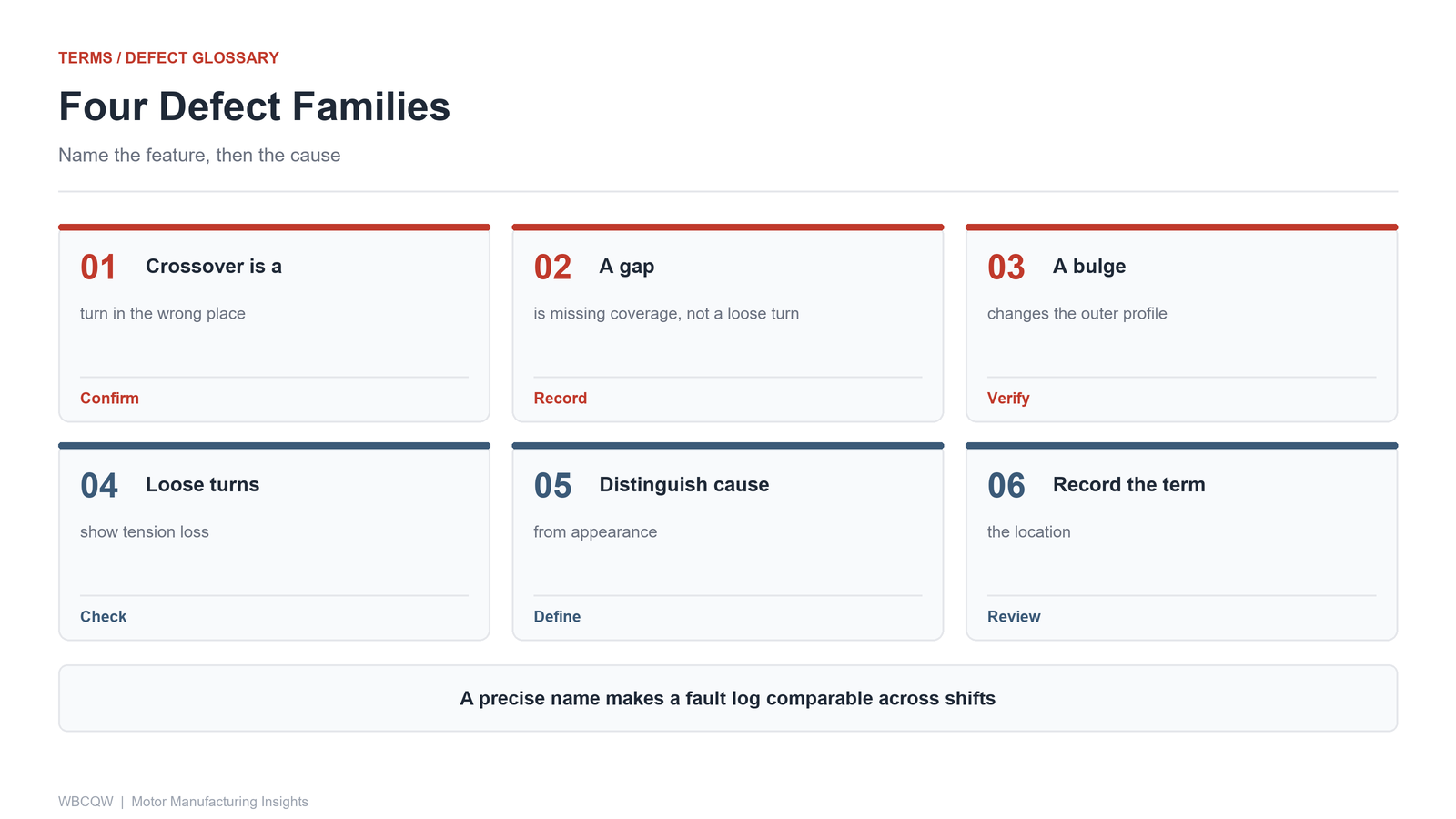
Fig. 2 - Four defect families and the feature that distinguishes each one. Illustrative diagram, not a product photograph.
A one-page defect glossary for a fault log
Put the whole set on a single sheet: term, plain definition, usual cause, and how it is detected, with a note on which feature wins when two terms could apply. Keep it beside the inspection station, not in a folder, and require the entry to name the layer and the angular position where possible. A log that records a precise name, a location and a program revision is enough to separate a repeating machine fault from a one-off handling fault.
Such a sheet has limits and they should be written on it. It standardises language, not judgement, and it cannot turn a visual call into a measurement. Two trained inspectors may still disagree at a boundary, and a glossary does not replace a retained sample or an electrical test. Used as a shared reference rather than a verdict, though, it makes the fault log reproducible enough to act on, which is the only reason to keep one.